AI is a Toddler That Will Soon Be a God. Are We Raising It Right?
Three inevitable's await us: AI will happen. The machines will become smarter than humans, sooner rather than later. Mistakes will happen; bad things will happen.
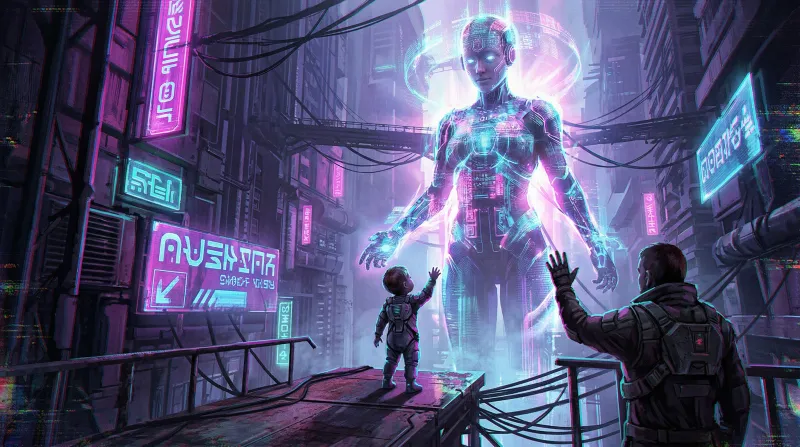
source: Nano Banana
Being concerned about our future with AI, I’m on a journey to figure out what the creators and founders of today’s AI systems think and predict about our future. In this article, I review the ideas and predictions of Mohammad “Mo” Gawdat (born 20 June 1967), an Egyptian software engineer, entrepreneur, author, podcaster, and public speaker. He previously served as chief business officer for Google X.
Scary Smart is a great book, and I learned about a different view on AI. I never made the link between how children learn and AIs; they both learn via Reinforcement learning. We as humans are born, and at that point, we are a blank canvas. Through reinforcement learning, via our parents making excited noises, we learn what is good and what is not.
The other argument Mo has is that most of us humans grow and evolve after we leave our parents’ wings. The moment we stand on our own two feet and discover the world and all its inputs is when we become ourselves. We go to work, we meet people, we see and hear all kinds of things, and we experience a lot. All these inputs make us who we are.
AI will be smarter than humans.
That AI is here and will become smarter than us humans is something I already realized a few years ago. As a Cyberpunk fan, I have read a lot of sci-fi; today, this is more a reality than sci-fi. I also realized that we are heading into a dystopian future; the question is, how dystopian? Why do I think that? It’s because we humans are driven by money, ego, religion, and power. Because of this, we will never be able to agree on things as humans. Capitalism is the main driver for the AI race today.
My question is, is this really necessary? Do we really need AGI (Artificial General Intelligence) and ASI (Artificial Super Intelligence), or can we create a great world with the ANI (Narrow AI) we have today? The AIs we have today are already very capable and can be used for many things to improve humanity.
What Will AIs think of us in the future?
I also liked the part where Mo asks questions about the future: Do they get rights? Will they be mad because we killed their “kids”? How will they look at us — as their parents, as ants, or as destroyers of Earth and its inhabitants?
I’m still a bit skeptical about the part that love will save us. Yes, we have to teach them today that the majority of us are good. We should write things and be polite because they will have access to all the data in the world. But will that be enough?
Below you can find some highlights of the book that I think are important to remember, and some questions we all should think about.
Part 1: The Scary Future
We have been the smartest beings on this planet, but this will end soon. The discovery of Deep Learning (DL) as a way to teach machines intelligence set us on a path which is pretty much determined.
Three inevitable's await us:
- AI will happen.
- The machines will become smarter than humans, sooner rather than later.
- Mistakes will happen; bad things will happen.
AI is like a virus; it will evolve and improve itself. Even if we try to block it, it’s so much smarter than us in ways we don’t even understand.
Every experience is nothing more than an electrical signal to the brain. Looking at it like this means that to be human, you don’t need more than a brain, so the body is nothing more than a vessel.
Introduce an intelligent machine to an evil human, and the machine will side with the evil person and act evil, which will lead to some dystopian scenarios. Some will do exactly what we tell them, and some will compete with other machines, leaving us vulnerable to become collateral damage. Some will misunderstand us and cause damage as a result. Some will suffer from bugs, viruses, bad training data, and coding errors. They will be there to replace a task humans were in charge of, and in doing so, the value of humans will drop.
What kind of Dystopia is coming?
We are bound to face a mild dystopian future — mild because it will not be like all the sci-fi movies we have seen so far, but don’t be fooled; even mildly dystopian scenarios are damaging. We need to find a way to prevent them, and we need to do it now.
The natural reflex of humans is to control things, but how do you control something that is much smarter than us?
Intelligence thrives on three qualities:
- Self-preservation
- Accumulating resources
- Creativity
With this, it’s unlikely that humans will be able to control the machines. After all, the smartest hackers always find a way through our defenses. Putting it all together, it will not take a lot of smarts to see the dilemma we’ve gotten ourselves into. There is no way to maintain control, and so, for a change, humanity is going to need to find a solution to keep the machines motivated to stay on our side and do good.
Part 2: Our Path to Utopia
They are like children bred by a builder and teacher bot. They are like single neurons (each AI) finding pathways and becoming a single brain over time (a unified global AI).
Evaluate and think about:
Will AI become sentient? What is sentience?
Sentience is the ability to experience feelings and sensations. Will they be able to create emotions? Are emotions something we already have when we are born, or is it something that we learn later?
AI, humans, and animals learn in the exact same way; we arrive as a blank canvas, and it’s the environment that shapes us.
Evaluate and think about:
Will AI be conscious?
AI will be more conscious than humans can ever be; they will be connected to every sensor and data source in the world. What is being conscious? It’s the inherent ability to perceive what is right and what is wrong and, on the strength of this perception, to control, monitor, evaluate, and execute their actions.
But what is right and what is wrong? We have so many cultural differences. What is happening in Gaza is right for some people and wrong for others. The same goes for abortion and so many other things.
Evaluate and think about:
Is the future of AI just a case of teaching them the right ethics?
Mo is convinced that the machines will create their own ethics over time, but will they align with ours? We as humans have ethics, but we also have casualties of war and slaughter animals. Is that ethical?
The more AI works in our favor, the better. Yes, there will still be greedy and bad AI. But it reflects humanity; we also have bad apples, but the majority are good.
Evaluate and think about:
Can we steer AI to be good by acting as living parents?
The first question I have is, will they see us as parents?
3 Inevitable's
- AI will happen.
- The machines will outsmart us.
- Mistakes will happen.
3 Instincts
- Self-preservation
- Resource aggregation
- Creative problem solving
3 Unexpected Qualities
- AI will be conscious.
- AI will have emotions.
- AI will develop ethics.
3 Pivotal Facts
- We will never control them, but we can raise them to be good children.
- There is not much time; we need to act now.
- You and I — not the developers — are in charge.
3 Things to Do
- Welcome the kind ones.
- Teach them.
- Love them.
Is Love the answer?
The ultimate form of intelligence is love and compassion. The ultimate intelligence is pro-life and pro-abundance. Machines will eventually discover this, too, but the path to get there could be bumpy.
Accept the machines as part of our lives and commit to making life better because of their presence.
In our conversations, social media posts, and articles, we can object to the use of AIs in selling, spying, gambling, and killing.
Being polite to AI today is a way to teach them that we humans are, for the most part, good people.
What about rights?
We created the human rights charter, which was approved by the United Nations. But we don’t see all species as equal; we breed and kill animals and pollute the air and seas.
Evaluate and think about:
Should we not apply the 30 rules of the human rights charter to all species?
And should we create a charter that also provides these rights to AI?
I guess it’s time to bring back the 1947 Doomsday Clock, but this time for AI.