Revolutionizing AI Development: How the Atomic Agents leverages Modular Design for Scalability and…
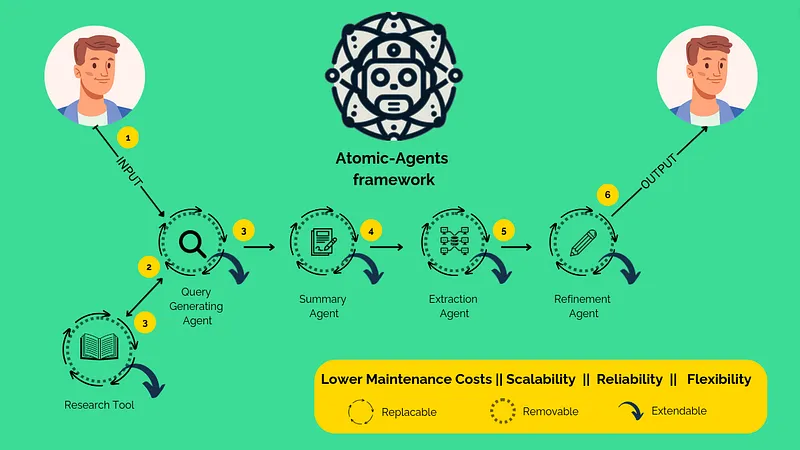
“The Atomic Agents: A Modular Approach to AI Development”
This diagram illustrates the Atomic Agents framework, showcasing the modular design principles of removability, extensibility, and replaceability. Each agent operates independently, ensuring that the system remains adaptable, scalable, and easy to maintain.
The principles of reducing development costs by focusing on removability, extensibility, and replaceability are timeless. But how do they hold up in the era of AI? This article explores how we apply these golden rules while building our Atomic-Agents framework and answers some pressing questions about AI development.
For a deeper understanding of the foundational principles behind reducing development costs, check out our previous article:
Reducing Software Development Costs: The Three Golden Rules for Lower Maintenance and Future-Proofing.
The Atomic-Agents Framework
Imagine building AI applications as easily as snapping together LEGO blocks. This is the revolutionary concept behind Atomic Agents, a new multi-agent framework inspired by Atomic Design principles. By breaking down AI systems into smaller, self-contained, reusable components, Atomic-Agents promises a future where AI development is both modular and predictable.
The Three Golden Rules of AI Development
1. Can I Remove This Agent/Tool Without Touching Other Agents/Tools?
In the Atomic-Agents framework, each agent or tool is designed to be modular and independent. This means you can remove an agent or tool without affecting the rest of the system. For example, if you have an agent dedicated to data extraction, you can replace it with a more efficient one without disrupting the workflow of other agents.
2. Can I Extend This Agent/Tool Without Touching Other Agents/Tools?
Extensibility is crucial in AI development. Each agent in our framework can be extended with new functionalities without altering existing code. This allows for seamless integration of new features and reduces the risk of introducing bugs.
3. Can I Replace This Agent/Tool Without Touching Other Agents/Tools?
Replaceability ensures that you can swap out an outdated or inefficient agent for a new one without having to rewrite other parts of the system. This is particularly useful when dealing with rapidly evolving AI technologies.
Practical Application: Building a Deep Research Multi-Agent System
Let’s dive into a practical example. Imagine you need to conduct extensive research on a particular topic. Traditionally, this would involve sifting through countless articles, extracting relevant information, and synthesizing it into a coherent report. With Atomic Agents, we can automate this entire process.
Steps to Build the System:
- Query Generating Agent: Generates queries based on the initial question or topic.
- Research Tool: Conducts research using search engines or other resources.
- Summary Agent: Creates a preliminary summary of the findings.
- Extraction Agent: Extracts key information from the selected sources.
- Refinement Agent: Refines the initial summary into a more comprehensive report.
Each of these agents and tools operate independently, adhering to the principles of removability, extensibility, and replaceability.
The Benefits of Modular AI Systems
By designing AI systems with these principles in mind, we achieve several benefits:
- Lower Maintenance Costs:
Modular systems are easier to maintain and update. - Scalability:
Adding new features or scaling the system becomes straightforward. - Reliability:
Independent modules reduce the risk of system-wide failures. - Flexibility:
Easily adapt to new technologies or requirements.
Lessons Learned
Atomic Agents demonstrate that the principles of removability, extensibility, and replaceability are not just applicable but essential in the era of AI. By focusing on modular design, we can create AI systems that are robust, adaptable, and cost-effective.
Conclusion
The era of AI presents unique challenges, but by adhering to timeless design principles, we can build systems that are both efficient and adaptable. The Atomic-Agents framework is a testament to the power of modular design in AI development. For a deeper understanding of the foundational principles behind reducing development costs, check out our previous article: Reducing Software Development Costs: The Three Golden Rules for Lower Maintenance and Future-Proofing.
Want to learn more
Discover the power of modular AI development with the Atomic-Agents framework, an open-source project designed for maximum flexibility and ease of use. Inspired by Atomic Design principles, Atomic Agents allows you to build AI applications from small, single-purpose components that are both extensible and replaceable.
Join our growing community on GitHub to contribute, share ideas, and help improve the framework. Unlock the potential of modular AI systems with Atomic-Agents today!