The Cognitive Assembly Line: Eradicating Semantic Debt with the Atomic Agentic Fabric
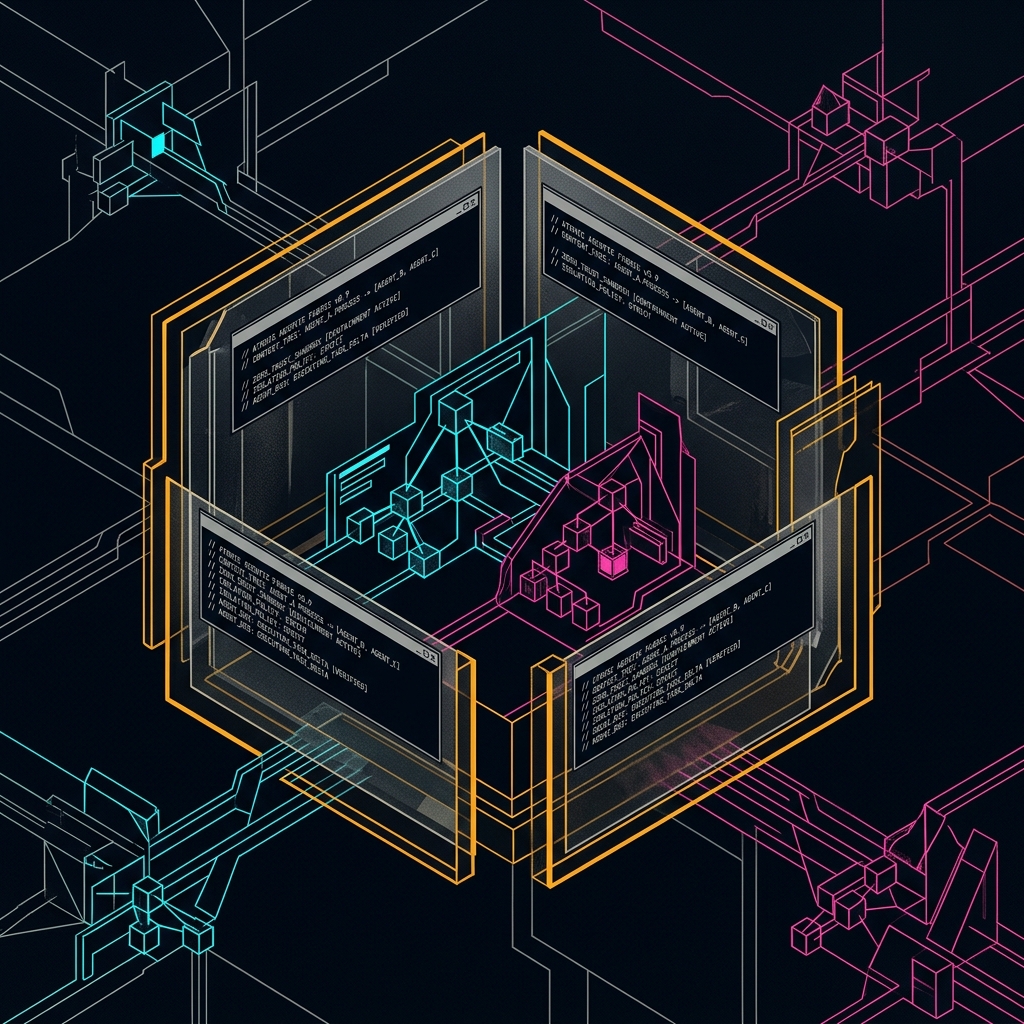
What follows is a vision for the next evolution of the SDLC. While this represents a unified conceptual blueprint, several isolated components, such as the Zero-Trust WASM Sandbox and the Sprawl CLI orchestration layer, are already functioning in production. The current mandate is aggressive iteration and system-wide unification.
Most modern AI projects are building on quicksand. In the rush to deliver "agentic" capabilities, enterprise engineering teams are accumulating a perilous new form of technical liability: Semantic Debt.
We see it in every codebase. A brittle accumulation of hard-coded prompt logic, tightly coupled to proprietary LLM APIs - or worse, suffocated by rigid, untraceable wrapper libraries like LangChain that obscure the actual execution. When the model updates, the logic breaks. When the vendor shifts, the architecture collapses. It is the equivalent of installing a Ferrari engine into a wooden horse cart, tying it down with duct tape, and hoping the transmission holds.
It will not hold.
Enterprise AI evolution requires a brutal, uncompromising paradigm shift. We must force software engineering away from manual "Construction" - the act of writing endless, fragile lines of code to bridge unpredictable AI output - and toward the deterministic discipline of "Orchestration". We must orchestrate intent.
This manifesto outlines the Atomic Agentic Fabric (AAF) methodology. This is the blueprint for how we de-risk AI at the enterprise scale. By leveraging Intent-as-Code, a centralized governance nervous system called The Sprawl, the rigid Atomic Hierarchy, and ultimately a Zero-Trust Fission Sandbox, we eliminate hallucination-driven failure and replace it with a cognitive assembly line.
1. The Core Philosophy: Eradicating Semantic Debt
Semantic Debt is the silent killer of enterprise AI velocity. Traditional technical debt occurs when developers take shortcuts in code architecture to ship faster. Semantic Debt occurs when developers intertwine non-deterministic, probabilistic logic (prompts) directly with deterministic execution pathways (the actual software).
The Agnostic Posture
To survive the next decade of foundational model volatility, the architecture must adopt an Agnostic Posture. The underlying language model is simply a swappable limb. It is a processor, a localized cognitive engine. The architecture must survive, unchanged and unbroken, regardless of whether it is driven by OpenAI, Anthropic, or an open-weight model running locally.
When you decouple the reasoning engine from the execution environment, the true Intellectual Property of the enterprise shifts. The value is no longer in writing hundreds of lines of fragile parsing scripts. The true value shifts to your Intent Schemas - the deterministic, version-controlled blueprints that define exactly what the AI is allowed to do, what data it is allowed to touch, and what shape its output must take.
This is Intent-as-Code. To successfully scale this philosophy of orchestration across 10,000+ employees, we must divide our roadmap into what we govern today, and how we execute tomorrow.
Part I: Governance & Foundation (The Reality of Today)
The immediate focus for any enterprise serious about agentic workflows must be curing infrastructural fragmentation. We must distribute a standardized, atomic architecture that enforces boundaries. Currently, enterprise AI adoption is chaotic. Developers spin up random silos, duplicate core prompts, misalign data structures, and lack any meaningful security perimeters.
We resolve this by enforcing the Atomic Hierarchy and orchestrating it via The Sprawl.
2. The Atomic Hierarchy: Nouns, Verbs, and The Workforce
To prevent context chaos and guarantee predictable execution, every component within the system boundary must follow a strict, enforced classification. Whether we are scaffolding local folders today or executing fully autonomous code tomorrow, the Atomic Hierarchy ensures absolute predictability:
- Atoms (The Nouns): These are the strict, type-safe data structures. Atoms are the only currency allowed in the system. They are implemented as rigid Pydantic models (e.g., TaxRecord, LogData, UserSchema). They define the exact shape of reality the system understands. If output does not match the Atom, the system rejects it - an architectural immune response to hallucination.
- Molecules (The Verbs): These are singular, deterministic Python functions focusing purely on one action execution (e.g., Search_Web, Query_Database, Calculate_Variance). Molecules have no cognitive drift. They receive an Atom, execute a hardcoded operation, and return an Atom.
- Organisms (The Workforce): Defined explicitly in an AGENTS.md manifold. An Organism is a specific set of rules acting as a Persona, equipped with an interchangeable LLM Brain and access to a highly restricted set of Molecules. It is a specialized worker on the assembly line, unaware of the broader factory.
- Agentic Constructs: The isolated, physical silos where Organisms are deliberately grouped together to resolve complex, intent-driven Manifests.
3. The Central Sprawl (The Governance Layer)
You cannot scale 100 autonomous agents if every developer is defining "how to search the web" differently. The Sprawl is the company’s version-controlled DNA.
The Sprawl is a central, unified Git repository that manages all organizationally approved Rules, Molecules, and Workflow patterns. It is the singular source of truth for the enterprise's entire AI capability. It acts as the central brain from which all local instances inherit their logic.
To push this standardized DNA to the edges of the network, directly onto employee laptops, we deploy The Sprawl CLI. This is the orchestration engine:
- Orchestration Command: An employee runs
sprawl init "Finance Auditor". - Scaffolding & Replication: The CLI authenticates, pulls from the Global Sprawl, and instantly generates the localized Agentic Construct directly inside the employee's project workspace.
The developer doesn't write AI logic; they orchestrate pre-approved intent.
4. The Synthesis Pipeline: Redefining Human Roles
Agile methodologies were built around the limitations of human typing speeds. In the agentic era, we must re-tool our teams to utilize the 10:100 rule: 10 humans architecting and overseeing 100 agents. We achieve this by establishing the Synthesis Pipeline, populated by refined roles:
- The Experience Architect (UX): This architect determines the "Visual Atoms" and defines the overarching Semantic Intent of the product. They are concerned with what the system means to the user.
- The Data Synergy Lead: Operating two sprints ahead of the assembly floor. Utilizing crisp data mining protocols (CRISP-DM), they ingest source APIs, sanitize inputs, and produce the rigid data flows and algorithmic boundaries that the agents will consume.
- The Matrix Ops (MOps): The guardian. They maintain the pristine global repository (The Sprawl) and manage the local infrastructures. They dictate what logic is allowed onto the floor.
- The Intent Engineer: The rapid-assembler. The Intent Engineer does not write massive boilerplate files. They snap pre-validated Atoms and Molecules together to fulfill the pipeline at 5x the traditional velocity.
5. Architectural Directory Structures
This entire philosophy translates directly onto the hard drive. We distinguish clearly between the Global Brain and the Local Worker.
A. The Global Governance Repository (The Sprawl)
Managed strictly by Matrix Ops, this hub contains the CLI tooling and the pristine master library.
📁 the-sprawl/
├── 📁 .agent/ <-- Internal agent managing this governance repository
├── 📁 Rules/ <-- Global central policies
├── 📁 Skills/ <-- The master library of Python/WASM Molecules
├── 📁 packages/ <-- The Distribution Hub
│ ├── 📁 cli/ <-- The `sprawl` CLI orchestrator engine
│ ├── 📁 core/ <-- Scaffolding templates and definitions
│ └── 📁 vscode-extension/ <-- Sprawl IDE Extension
└── 📄 install.sh <-- The Corporate Installer
B. The Local Agentic Construct (.agents/)
This is what the Intent Engineer receives upon running the sprawl init command. It is an isolated, zero-trust schema perfectly mirroring the Atomic hierarchy.
📁 .agents/
├── 📁 rules/ <-- Inherited Procedures & Boundaries
├── 📁 skills/ <-- Inherited Molecules (Verbs)
├── 📁 workflows/ <-- Active Intent Manifests
├── 📁 state/ <-- The compliance logs
├── 📄 AGENTS.md <-- Organisms (Personas / Local DNA)
└── 📄 mcp_config.json <-- Connectivity Route
Part II: The Future Autonomous Vision (The Fabric)
While Phase 1 standardizes the enterprise SDLC through the Sprawl CLI, Phase 2 evolves the underlying execution environment itself. Once governance is solved, we transition away from native, host-level scripting. We deploy the true Atomic Agentic Fabric (AAF).
The localized constructs will stop running arbitrarily on a developer's machine and will execute natively within a new, highly constrained engine.
6. Code as a Disposable Byproduct: The Zero-Trust Fission Sandbox
Traditional computing relies on heavy OS-level containerization (Docker, Kubernetes). These are slow, stateful, and overkill for massive, rapid multi-agent execution. AAF introduces the Zero-Trust Fission Sandbox, driven by WebAssembly (WASM).
- The Mechanism: An isolated, logic-less engine. It takes the Intent Schemas, generates the necessary executable code dynamically, executes it natively via Pyodide or Node.js bridges, and then, critically, natively destroys the memory instance upon completion.
- Disposable Syntax: In the AAF, software syntax is thrown away instantly. Code acts like temporary kindling used to spark a transaction. If the Organism hallucinates malicious logic, the sandbox is burned to the ground with zero host damage. Nothing bleeds out.
This completely eliminates "organ rejection" within the enterprise architecture because the execution layer has no persistent state to corrupt.
7. The State Bus and Physical Observability
Because the code is disposable and Organisms are isolated in Fission Sandboxes, they require a foolproof, physical ledger to communicate line-items of reality. We eliminate arbitrary "chat."
- The State Bus: Organisms do not sit in a Slack-like loop negotiating with one another. They strictly pass Atoms (rigidly defined Pydantic JSONs) over a state bus to the next Organism in the manifest.
- The Physical State Ledger: Every action, every decision, and every atom exchange drops a literal .state.json file into the file system (e.g., .agents/state/step_01.state.json).
When things break, you do not try to "debug the AI" by reading a massive, probabilistic chat transcript. You physically read the file system log. By enforcing ISO-level observability by design, humans are finally removed from the agonizing loop of arbitrary code debugging, allowing them to focus entirely on orchestrating logic steps.
The Mandate
The era of writing 10,000 lines of fragile glue code to tape an LLM to a database is over. The enterprises that survive will be those that transition from manual coders to cognitive orchestrators.
If your architecture still relies on developers wrapping arbitrary logic around unconstrained model outputs, your system is already obsolete. The Atomic Agentic Fabric is not a tool; it is the absolute baseline requirement for operating AI at scale.
Diagnose your friction, construct the Sprawl, enforce the Sandbox, and eradicate your semantic debt. The cognitive assembly line is ready for deployment.
This architecture requires merciless discipline to implement. If your enterprise is drowning in agentic fragments and requires a unified, B2B engineering mandate to deploy the AAF protocols natively, initiate a dialogue with me as your Independent Architect.