The Developer Agent Governance Framework: How Engineering Teams Safely Scale Autonomous Coding Agents from Shadow Tools to Governed Runtimes
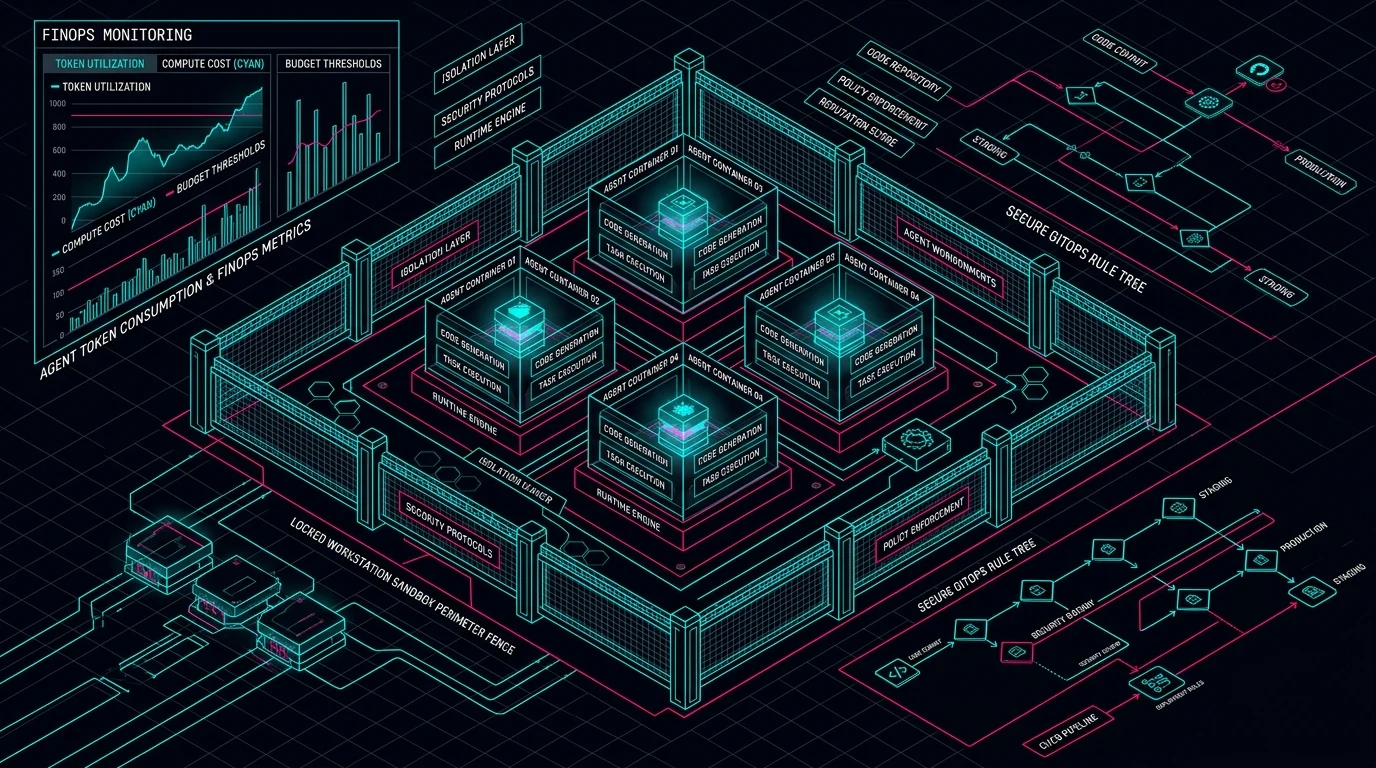
If you run an engineering organization, take a close look at your last three months of API invoices and Git commit logs.
Right now, most founders and engineering directors believe they have an "AI adoption" problem. You bought team licenses for Cursor, Windsurf, or Claude Code. You ran an internal lunch-and-learn on prompt engineering. You told your developers to move faster.
Then the reality on the ground hit:
- Codebase Bloat: Your senior engineers are spending half their mornings untangling 400-line PRs filled with repetitive logic and phantom dependencies.
- Financial Hemorrhage: The moment developers move from passive autocomplete to autonomous CLI agents (Claude Code, Cline, SWE-agent loops) on raw API keys, token spend explodes into thousands of dollars per developer each month, yet your feature delivery rate has barely budged.
- Silent Exfiltration: Your security team is quietly terrified because nobody knows what local
.envsecrets, customer schemas, or proprietary algorithms those autonomous agent loops are hoovering into external context windows.
You do not have an adoption problem. You have an uncontained runtime crisis.
When an autonomous coding agent thrashes in a recursive loop on a developer's machine, it does not just write code. It crawls parent directories, ingests build artifacts, re-reads thousands of lines of dead context, and dumps 70,000 tokens into the model API two hundred times a day. You are not paying for reasoning. You are paying a massive, unbudgeted tax on context bloat and unconstrained filesystem traversal.
For the past year, I have operated on both sides of this line: building lightweight, zero-dependency developer AI governance tooling in my terminal late at night, and advising enterprise engineering organizations by day as a Fractional Head of AI & Enterprise Systems Architect.
I watched company after company attempt to fix this with "AI Enablement" programs: soft workshops teaching engineers how to write better prompts. It fails every single time. You cannot fix a systems architecture failure with conversational advice.
You need structural governance.
Here is the exact 5-stage framework I use to transition engineering teams from chaotic shadow AI to governed, cost-clamped, and audit-compliant agent runtimes.
┌────────────────────────────────────────────────────────────────────────┐
│           THE 5-STAGE DEVELOPER AGENT GOVERNANCE FRAMEWORK             │
├────────────────────────────────────────────────────────────────────────┤
│ STAGE 1: The Workstation Audit & Shadow AI Inventory                   │
│          Diagnose the bleeding: map active agent runtimes, token spend,│
│          and git code churn.                                           │
├────────────────────────────────────────────────────────────────────────┤
│ STAGE 2: Workstation Boundary & Scope Governance                       │
│          Enforce physical directory scoping: block traversal into      │
│          sibling repos, unmasked .env secrets, and host services.      │
├────────────────────────────────────────────────────────────────────────┤
│ STAGE 3: GitOps Context & Rule Standardization                         │
│          Replace brittle personal prompts with version-controlled      │
│          rules, skills, and subtrees synced across developer repos.    │
├────────────────────────────────────────────────────────────────────────┤
│ STAGE 4: Token FinOps & Out-of-Band Telemetry                          │
│          Reconcile token spend against merged code: clamp context      │
│          runaway and kill the rogue loop tax.                          │
├────────────────────────────────────────────────────────────────────────┤
│ STAGE 5: Audit Attestation & Enterprise Compliance                     │
│          Generate hash-chained local session logs to satisfy DORA,     │
│          SOC 2, and ISO/IEC 42001 governance clearance.                │
└────────────────────────────────────────────────────────────────────────┘
Stage 1: The Workstation Audit & Shadow AI Inventory
Before you can govern developer execution, you must measure the baseline reality.
In almost every organization I audit, executive leadership believes they have standard Copilot auto-completion deployed. When I inspect actual developer endpoints, I find senior engineers running autonomous Agent loops, junior engineers running unmetered Claude Code sessions, and multiple unvetted MCP servers wired directly to local databases.
The first step is a clinical, objective audit across three vectors:
- Tooling Surface: Exactly what agent runtimes, IDE extensions, and CLI daemons are active on developer machines?
- Financial Bleed (The Rogue Loop Tax): How many raw API tokens are developers burning per week? What percentage of those tokens resulted in code that merged vs. code that was discarded after twenty failed iterations?
- Code Quality & Churn: What is happening to your repository health? GitClear's research demonstrated a 2x increase in code churn and a steep drop in code refactoring across AI-assisted teams. When commit logs show massive additions followed immediately by massive deletions, your team is thrashing. This directly degrades your DORA metrics: spiking your Change Failure Rate (CFR) through phantom regressions and inflating PR Review Cycle Time as senior engineers become exhausted copy-editors for AI slop.
You cannot manage what you do not log. Stage 1 establishes your actual token burn rate, your code churn ratio, and your shadow tool footprint.
Stage 2: Workstation Boundary & Scope Governance
Once you know what tools are running, you must lock the physical perimeter.
Most enterprise security teams try to solve AI data leakage at the network layer using cloud HTTP inspection proxies. This is architecturally broken. By the time an outbound proxy inspects a payload sent to Anthropic or OpenAI, the agent on the developer workstation has already traversed out of the project repository, scraped an uncommitted .env.local containing unmasked staging database credentials, or read proprietary logic from a sibling client project open in the same workspace. The leak has already happened on the machine.
Autonomous agents must be bounded across two synchronized boundaries at the workstation repository boundary and execution level:
- Directory-Locked MCP Servers: When an agent invokes file reading, grepping, or editing tools, the bridge must be strictly pinned to the active repository root. The agent must be physically incapable of reading parent directories, sibling client workspaces, or uncommitted local environment secrets.
- Permission Gating & Pre-Approved Execution: Unattended execution privileges create massive defect risk. Terminal commands must execute with explicit developer approval and pre-commit validation gates rather than unconstrained shell autonomy.
- Service & Subtree Scoping: Agents must only touch the specific mock services, test databases, and subtrees explicitly declared for that task.
- Zero Host Modification: The agent runtime should never alter global shell configurations, install untracked system binaries, or access unmasked credentials on the host machine.
Lock the directory gate locally. If the agent cannot read outside the project root, it cannot leak what it cannot touch.
Stage 3: GitOps Context & Rule Standardization
The single greatest source of developer frustration and cognitive fatigue is "prompt drift."
Developer A writes a custom 50-line markdown prompt explaining the repository architecture. Developer B uses whatever default prompt their IDE shipped with. Developer C forgets to tell the model to avoid deprecated internal APIs, leading to three hours of debugging broken tests.
In Stage 3, you eliminate personal prompt folklore and replace it with version-controlled GitOps governance:
- Repository-Bound Architectural Rules: Architectural constraints, coding standards, and security mandates live directly inside the repository (under a standardized
.agents/hierarchy) committed to Git. - Deterministic Skill Ingestion: Instead of dumping an entire 10,000-line documentation manual into every prompt, provide scoped, modular skills that the agent only reads when a specific task triggers them.
- Fleet Synchronization: When your Lead Architect or CISO updates a security boundary or deprecates a database driver, they do not send a Slack message hoping engineers read it. They update the rule in a central governance repository and sync it across fifty developer repositories with a single Git command.
The repository becomes the single source of truth for both human engineers and autonomous agents.
Engineering leaders often hesitate here, fearing that governance boundaries will trigger developer revolt or slow shipping velocity. In practice, the opposite occurs. Governed runtimes increase net velocity: because developers stop wasting four hours fighting context drift, debugging hallucinated packages, and un-breaking dirty git trees.
Stage 4: Token FinOps & Out-of-Band Telemetry
Now that your boundaries and rules are standardized, you address the economic hemorrhage.
When an engineer says "Claude Code just cost me $40 this afternoon on a single bug," they usually blame model prices. That diagnosis is wrong. The model is not expensive: the unmanaged context payload is.
In an unconstrained setup, an agent looking for a bug will casually grep through node_modules, read compiled binaries, and re-inject 80,000 tokens of static noise into the context window on every single turn.
Stage 4 implements local, out-of-band telemetry and context clamping:
- Subtree Clamping: Force the agent to operate exclusively on relevant subtrees rather than sweeping the entire disk. In my own benchmarks, clamping the active workspace boundary reduces token consumption by 60% to 80% immediately, without downgrading model intelligence.
- Out-of-Band Session Tracking: Collect local execution metrics (tokens consumed, files modified, tool calls executed) without routing developer traffic through high-latency third-party cloud proxies.
- Merge Reconciliation: Reconcile session tokens directly against merged PRs. If a developer burns 2,000,000 tokens on a task that results in twenty lines of YAML, your telemetry highlights the anomaly before the end of the billing cycle.
You transition from blind monthly cloud bills to deterministic, per-task unit economics.
Stage 5: Audit Attestation & Enterprise Compliance
The final stage is what transforms developer AI from an internal engineering experiment into an enterprise-grade corporate capability that satisfies your legal, compliance, and risk committees.
Under emerging regulatory standards - including DORA (Digital Operational Resilience Act for European financial entities and ICT third-party providers), SOC 2 Type II change controls (CC6.8, CC7.2, CC8.1), and ISO/IEC 42001 - organizations must be able to prove how automated systems interact with production software. For engineering teams building software deployed into high-risk domains under the EU AI Act (where Article 14 mandates human oversight), or preparing for downstream supply chain transparency, ungoverned AI generation on developer laptops is an audit failure waiting to happen.
If a critical vulnerability or data leak reaches production, saying "the developer was using an AI tool on their laptop" will fail an audit immediately.
Stage 5 delivers cryptographic and tamper-evident local auditability:
- Session Context Proofs: Hash-chained session logs anchored to Git commit SHAs, recording what context, rules, and files were ingested during code generation sessions and committed alongside the PR or streamed out-of-band to an append-only store.
- Human-in-the-Loop Attestation: Verifiable records confirming that a human engineer reviewed and approved tool execution steps before destructive commands ran on the workstation.
- CISO Compliance Bundles: Turnkey documentation proving that coding agents run within governed repository perimeters with zero unauthorized external telemetry or secret exposure.
When your sales team bids on high-ticket enterprise contracts, you do not stall in three-month security questionnaires. You hand their security review board an auditable compliance attestation proving your developers operate inside governed, monitored boundaries.
Moving from Theory to the Terminal
The industry is reaching the end of the initial "wild west" phase of generative coding.
The novelty of asking an LLM to generate boilerplate has worn off. What remains is the hard engineering reality: autonomous agents are powerful, recursive tools that will either accelerate your delivery or burn your margins, degrade your codebase, and expose your credentials if left uncontained.
You do not need another generic training seminar. You do not need another corporate PDF telling developers to be careful.
You need to lock your workstation boundaries, version-control your context rules in Git, clamp your token burn with local telemetry, and give your CISO an unassailable audit trail.
Stop building fragile systems on raw conversational prompts. If you run an engineering organization and need to govern developer agent sprawl across your team, let's architect the boundary.
Younes Baghor is a Fractional Head of AI & Enterprise Systems Architect. He advises European enterprise engineering leadership and systems integrators on developer AI governance, LLMOps FinOps, and deterministic software engineering.
If your engineering team is scaling autonomous agents or evaluating fractional AI leadership, book an architecture session: younesbaghor.com.
YOUNES_BAGHOR