Beyond the Chatbot: Why Desktop Agent Cockpits Are the Shift from Talking to Shipping
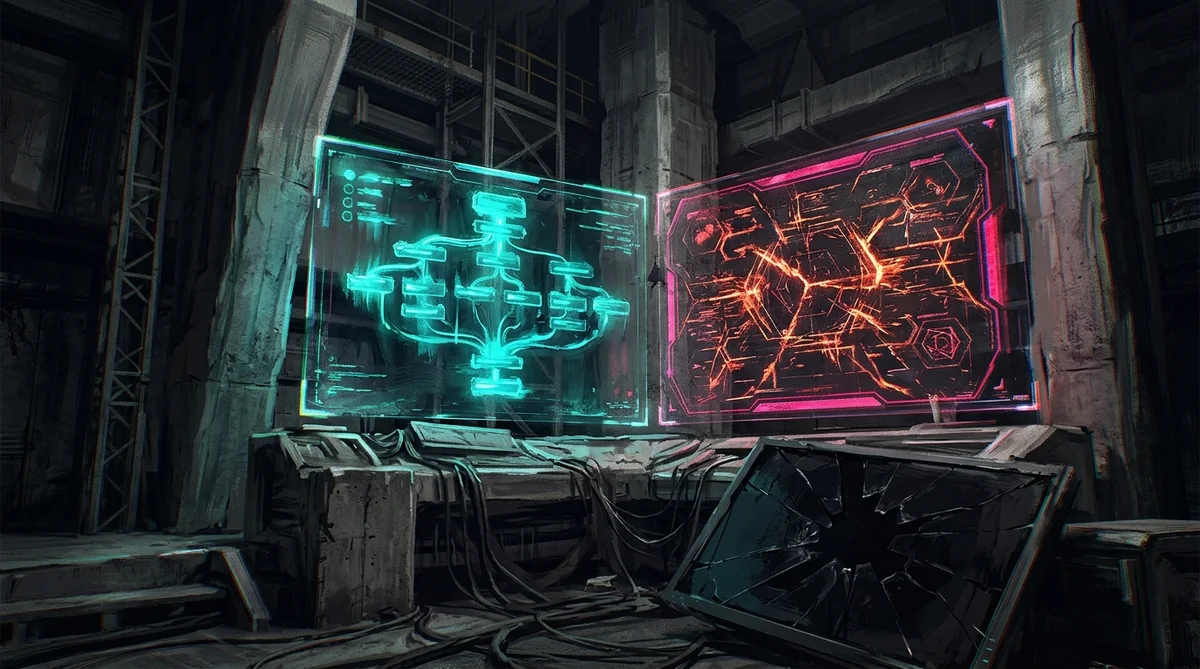
I stopped using browser-based chatbots for software engineering about 2 years ago.
Like everyone else in the initial generative AI wave, I was initially intrigued by conversational chat windows. You crafted a prompt, asked a model to draft an algorithm, and when syntax streamed back across the browser, it looked impressive.
Then the novelty wore off. In its place came the universal exhaustion that every lead developer and software architect recognizes:
"I am spending more time context-switching, copy-pasting diffs, and fixing hallucinated syntax than I would have spent typing the code myself."
That friction is the direct consequence of the Chatbot Fallacy.
In this paradigm, AI was treated like an external consultant: an entity sitting in an adjacent browser tab that gives well-intentioned advice, but never touches your local tools, never inspects your build logs, and never takes accountability for shipping code.
The industry is now undergoing a massive architectural correction: moving from conversational chatting to autonomous execution. We are transitioning from isolated chat windows to Desktop Agent Cockpits.
1. The Architectural Shift: Edit Plane vs. Orchestration Plane
The fundamental difference between a chatbot and an agent is agency backed by execution primitives. A chatbot responds to a prompt; an agent pursues a goal across a local filesystem.
In traditional conversational setups, you are the manual runtime. You write a prompt, the model outputs a Markdown code block, you locate the target file, paste the diff, run the linter, encounter a compiler failure, copy the error message back to the chat window, and repeat. The human developer is reduced to an API bridge between an LLM and a terminal.
Modern desktop agent cockpits (such as headless terminal environments like Claude Code, integrated IDE agents like Cursor, or dedicated orchestration cockpits like Google Antigravity) break this bottleneck by decoupling two distinct layers:
- The Edit Plane: Where you inspect files, evaluate architectural trade-offs, and maintain structural oversight.
- The Orchestration Plane: Where autonomous agents ingest local context, plan multi-step operations, spawn parallel child processes, and execute commands against a real filesystem.
┌──────────────────────────────────────────────────────────┐
│               DESKTOP AGENT COCKPIT                      │
├────────────────────────────┬─────────────────────────────┤
│      THE CONTEXT PLANE     │      THE EXECUTION PLANE    │
│  • Git Workspace Roots     │  • Sandboxed Terminals      │
│  • Rules (.agents/rules/)  │  • Linter & Build Loops     │
│  • Skills & Tool Schemas   │  • Subagent Concurrency     │
│  • Model Context Protocol  │  • Verifiable Artifacts     │
└────────────────────────────┴─────────────────────────────┘
When an agent operates inside an orchestration cockpit, it no longer asks you to test its hypotheses. It reads the local file tree, drafts an atomic implementation plan, writes the code, invokes the test suite in a sandboxed shell, observes the failure, fixes its own syntax, and presents you with a verifiable diff.
2. The Anatomy of a Modern Agent Cockpit
Regardless of which foundation model powers your workflow, any production-grade desktop agent cockpit must provide three structural surfaces:
1. The Context Assembly Plane
Context is the infrastructure of intelligence. In a modern cockpit, context is an assembled, reproducible state:
- Workspace Boundary Mapping: Direct ingestion of project directories, documentation vaults, and dependency trees.
- Declarative Rulesets: Standardized instruction files (such as
AGENTS.mdor.agents/rules/) that programmatically constrain agent behavior without relying on repetitive manual prompts. - Extensible Tooling (MCP): Dynamic tool binding via the Model Context Protocol, allowing models to query database schemas, inspect telemetry, or invoke local scripts deterministically.
2. The Execution and Verification Window
A true agent cockpit produces structured state transitions, not conversational chatter:
- Subagent Concurrency: The ability for a primary architect agent to decompose a high-level goal and launch focused subagents in parallel (e.g. one agent researching test patterns while another drafts the interface).
- Deterministic Artifacts: Generating dedicated Markdown specifications, architecture diagrams, and structured task boards that exist outside the ephemeral chat transcript.
- Session Telemetry: Live recording of every tool call, terminal command, and output stream, providing complete auditability.
3. Containment and Permission Gates
Giving an autonomous agent access to a local filesystem and shell is an intolerable liability without strict containment.
3. Governance: The Carmack Rule of Agent Sandboxing
The most critical architectural advancement in modern agent cockpits is not larger context windows or faster inference speeds. It is containment infrastructure.
If an agent has unrestricted access to the host operating system, a single hallucinated script execution can corrupt the developer's workspace or ingest unmasked staging secrets from .env.local into external cloud prompt payloads.
Enterprise-grade agent cockpits enforce containment through strict layers:
- Filesystem Isolation: The agent is locked to the workspace root. Any attempt to read or modify files outside the declared project boundary triggers an immediate hard interrupt.
- Terminal Sandboxing: Shell commands execute inside ephemeral, sandboxed process boundaries. Operations that require elevated privileges or external network access must halt execution and request explicit approval.
- Network Egress Boundaries: In sovereign development environments, raw HTTP requests are restricted to approved registries and APIs, preventing data exfiltration or unvetted package pulling.
Without these containment primitives, agentic development cannot survive enterprise compliance audits. With them, autonomous agents become safe, deterministic execution engines.
4. Operational Blueprint: Deploying an Agent Cockpit
For engineering organizations looking to migrate from conversational prompting to desktop cockpits, adopting this workflow requires operational discipline:
Phase 1: Establish Workspace Containment
Before issuing your first autonomous task, define your boundaries. Configure the cockpit's execution policy to require explicit approval for modifying shell commands, enforce read-only sandboxes for unfamiliar repositories, and isolate sensitive host directories.
Phase 2: Codify Architectural Rules into Files
Stop repeating yourself in chat prompts. If your codebase uses a specific error-handling convention, a strict domain-driven directory structure, or a pinned testing framework, codify it into a declarative rule file inside your repository. Modern cockpits ingest these rules automatically on every task initialization.
Phase 3: Enforce the Intent-to-Artifact Loop
Adopt a strict execution contract:
- Declare Intent: Provide the agent with the high-level objective and reference files.
- Review the Plan: Require the agent to output an implementation plan before touching source code.
- Inspect the Execution Trace: Monitor the terminal logs and test runs in the auxiliary pane.
- Audit the Diff: Never accept a blind merge. Inspect the resulting artifacts and commit atomically to version control.
5. The Invariant: Platforms Outlast Models
Frontier foundation models are commoditized engines. Every ninety days, a new reasoning benchmark resets the leaderboard. The model you use today will be replaced tomorrow.
What endures is the workspace architecture.
The organization that builds its engineering leverage around conversational chat interfaces remains trapped on a fragile treadmill of manual copy-pasting and prompt wrangling.
The organization that invests in local agent cockpits (declarative rules, sandboxed execution runtimes, atomic task decomposition, and verifiable audit trails) builds permanent infrastructure. The models are simply interchangeable engines swapped into the cockpit. The architecture remains sovereign.
Related Architecture Essays
- Previous in Series: First-Principles AI Coding: Five Strategies to Eliminate Cognitive Fatigue
- Next in Series: The Master Sector: Architecting a Model-Agnostic Agentic Workspace
- Containment Architecture: Why I Stripped Out Sandbox Bloat: The Pivot to Lightweight Workstation Containment
Architecting Autonomous Systems?
Stop building fragile monoliths on raw conversational prompts. If you are an engineering lead, CTO, or enterprise architect structuring sovereign agentic workflows, deterministic containment, or local developer governance:
- Advisory & Mandates: Connect on LinkedIn or explore younesbaghor.com.
- Workstation Containment: Explore the open-source GitOps engine at sprawl.software.
Younes Baghor
Fractional Head of AI & Enterprise Systems Architect | Founder, Sprawl.software