The Agentic Assembly Line: How I Shipped Sprawl v2 with Zero Merge Conflicts
Generative AI has a scaling problem. At the prototype stage, it feels effortless. But as soon as you attempt to refactor a dependency-heavy monolithic codebase into a production-grade application, the illusion shatters. Agents step on each other's toes, context windows degrade, and merge conflicts bring development to a dead stop.
In my advisory work, I consistently point out that AI projects do not fail because of model limitations; they fail because of broken architecture and undisciplined workflows.
Recently, I put this philosophy to the ultimate test: upgrading Sprawl CLI from a prototype script to a modular, public v2.0.0 Release Candidate.
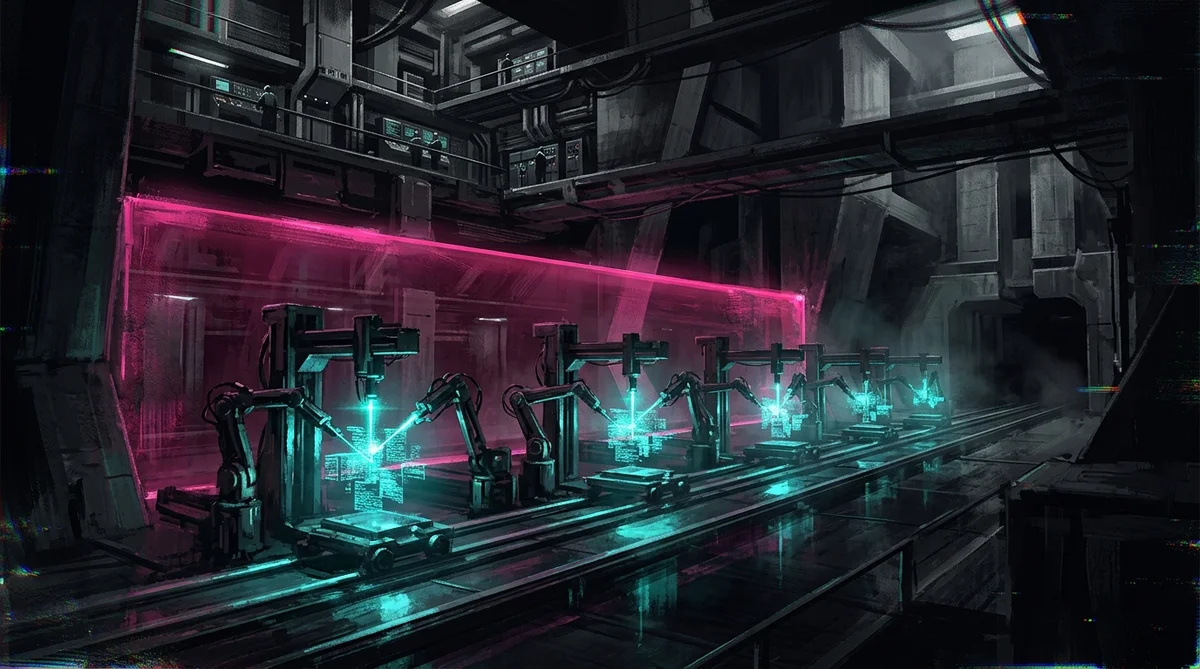
I did not just rewrite the tool manually. I engineered an autonomous, closed-loop assembly line to execute the refactor.
The output: 145 unit tests, zero failures, 0.068-second test suite execution, and exactly zero merge conflicts.
Here is the exact architectural blueprint I used to orchestrate it.
1. The Diagnosis: The Fragility of Ad-Hoc Prompting
The standard approach to AI-assisted development relies on ad-hoc conversational prompting. You feed snippets to an LLM, copy-paste the output back into your editor, and manually stitch the differences.
This methodology breaks down completely on large refactors. It forces you to maintain system state in your head, track complex cross-file dependencies, and referee code collisions.
When I set out to dismantle the monolithic core of Sprawl v1 and replace it with a modular, standard-library architecture, I knew conversational prompting would trigger prompt drift, context thrash, and regression bugs.
To build durable software, you need deterministic governance: strict physical file boundaries, automated execution loops, and a structure where the AI acts not as a chatty co-pilot, but as a disciplined worker on an assembly line.
2. The Architectural Core: Clean Room and Zero Dependencies
The defining success factor of Sprawl v2 was enforcing physical boundaries within the codebase. I established two core structural constraints:
The Clean Room Architecture
In early setups, agents operating in a workspace could inspect Sprawl's internal management files, causing context pollution and scope creep. In v2, I enforced a Two-Layer Stealth architecture:
- Layer 1: Stealth Injection (Workspace): The active repository contains only a lightweight
.agents/directory containing pure persona and rule definitions, anchored bysprawl_manifest.yml. - Layer 2: Management Plane: All active operational metadata (sync states, central DNA bindings, workspace registries) is kept strictly out-of-band in
~/.sprawl/workspaces/.
The agent remains completely unaware of the orchestrator governing it. Its context window stays lean, isolated, and focused exclusively on application source code.
The Single-Dependency Rule (Python stdlib)
To guarantee frictionless enterprise distribution and an auditable supply chain, I stripped out third-party packages. I eliminated Pydantic, PyYAML, Typer, and structlog.
Sprawl v2 ships with exactly one external runtime dependency: rich (for rendering terminal interfaces). Everything else, from workspace validation schemas to CLI argument parsing, relies purely on the Python standard library.
Using native dataclasses and an in-house regex frontmatter parser reduced our attack surface to near zero. It compiles in milliseconds on any developer workstation without dependency hell.
Universal Multi-IDE Binding
With the core engine stabilized, I built sprawl bind. This acts as a universal compiler, translating the sovereign policies in AGENTS.md directly into native configurations for Cursor, Windsurf, Claude Code, and Antigravity. Regardless of which editor an engineer prefers, the agent is bound to identical operational constraints.
3. The Design System: The Dual-Brand Divide
A common failure mode in technical marketing is attempting to force a single visual voice onto two different audiences. An enterprise leadership team evaluating security and TCO does not buy software with the same cues as an engineer optimizing their terminal workflow.
I resolved this by establishing a reactive Dual-Brand Design System managed by a global state trigger:
                  ┌──────────────────────────────┐
                  │     Global State Trigger     │
                  └──────────────┬───────────────┘
                                 │
         ┌───────────────────────┴───────────────────────┐
         ▼ (Theme: Brutalist)                            ▼ (Theme: Enterprise)
 [ YOUNES_BAGHOR Personal Brand ]                [ SPRAWL.SOFTWARE Corporate ]
 - Industrial Cyber-Brutalism                    - High-Precision Technical Minimalism
 - System Magenta & Atomic Cyan                  - Sovereign Emerald Green
 - Vibe: Fractional CTO / Trench Authority       - Vibe: Boardroom Governance
Brand 1: The Personal Operator (YOUNES_BAGHOR)
- Visual Identity: Industrial Cyber-Brutalism.
- Palette: System Magenta (
#ff007f) and Atomic Cyan (#00ffcc) set against a deep matte Void (#09090b). - Tone: Raw, empirical, practitioner engineering authority.
Brand 2: The Governance Gateway (SPRAWL.SOFTWARE)
- Visual Identity: High-Precision Technical Minimalism.
- Palette: High-Fidelity Emerald (
#10b981). - Tone: Risk-mitigated, predictable, and enterprise-compliant.
The 100-Character TUI Spec
I standardized all console diagnostic tools (sprawl doctor) to render at exactly 100 characters in line width (including borders). This eliminates jagged wraps and broken columns across varying terminal dimensions.
4. The Assembly Line: Executing the Epics
The operational backbone of the Release Candidate was my Markdown Project Management (MDPM) convention. I eliminated web-based project boards and replaced them with file-system-based markdown tasks inside a local repository.
The Project Scaffolding
I decomposed the v2 milestone into six bounded Epics:
EPIC-001: Core Monolith Dismantling (separating state from execution).EPIC-002: Workstation Registry Implementation (local~/.sprawlruntime).EPIC-003: DNA Ingestion and Sync Engine.EPIC-004: Python MCP Server with Path-Traversal Protections.EPIC-005: IDE Binding Engine (sprawl bind).EPIC-006: Terminal UI Interface.
Every Epic folder contained atomic Task documents with explicit acceptance criteria and exact file paths.
The Closed-Loop Directive
Instead of hand-holding, I launched execution agents with an uncompromising loop directive:
"Act as the Master Engineer. Navigate to this Epic directory. Pick the next 'To Do' task. Set status to 'In Progress'. Write the tests and code. Execute the test runner. Commit to Git. Set status to 'Review'. Move to the next task. Do not stop until the folder is empty."
To eliminate merge conflicts, I constrained concurrent execution to two agents operating on disjoint subtrees. The agents wrote, tested, and committed code sequentially. The pipeline compiled 145 unit tests and staged commits without human intervention.
Emergent Engineering Realities
- Autonomous Self-Correction: When a singleton contamination issue failed unit tests during the MCP server refactor, the agent parsed the stack trace, isolated the class instance, patched the test fixture, and re-ran the suite until it passed clean.
- Model Hot-Swapping: When our primary Claude API tier hit a quota limit mid-flight, I hot-swapped the model to Gemini. Because the operational state lived entirely in markdown files and Git commits, the new model picked up the exact task boundary instantly and continued execution without losing context.
Conclusion: Systems Thinking Over Model Hype
Shipping Sprawl v2 proved an immutable software rule: Agentic engineering is an exercise in systems architecture, not prompt trickery.
Foundation models are merely the combustion engines; the file boundaries, markdown state machines, and standard-library constraints are what steer the vehicle. High-fidelity structure produces high-fidelity output.
Syntax is temporary. Architecture is permanent.
Related Architecture Essays
- Previous in Series: The Master Sector: Architecting a Model-Agnostic Agentic Workspace
- Next in Series: The Standard Was Born From a Client Problem Nobody Wanted to Solve
- Benchmark Context: I Gave 7 AI Agents a Job: Here's What Actually Happened
Architecting Autonomous Systems?
Stop building fragile monoliths on raw conversational prompts. If you are an engineering lead, CTO, or enterprise architect structuring sovereign agentic workflows, deterministic containment, or local developer governance:
- Advisory & Mandates: Connect on LinkedIn or explore younesbaghor.com.
- Workstation Containment: Explore the open-source GitOps engine at sprawl.software.
Younes Baghor
Fractional Head of AI & Enterprise Systems Architect | Founder, Sprawl.software