Why I Stripped Out Sandbox Bloat: The Pivot to Pragmatic Developer AI Governance

The allure of a perfect technical sandbox is like a clean, high-density server rack. It hums with order. It promises absolute safety.
A few months ago, I was deep in the trenches of a proof of concept designed to solve the primary bottleneck of enterprise AI initiatives: How do we let an LLM write and execute code on a developer's machine without exposing the host system to secrets leakage and workspace corruption?
My initial solution was elegant, complex, and highly academic. I called it the Clean Sandwich Architecture. It used a three-layer isolation stack: a Python host orchestrating a Node.js bridge thread, which compiled and executed LLM-generated code inside a WebAssembly (WASM) Pyodide worker. The worker was spawned, ran the code in a completely isolated memory space, and was instantly destroyed.
It worked. It was secure. It made for a spectacular diagram.
And then I stripped it out.
Here is the story of that pivot, and why technical founders must learn to reject the "academic tech stack" in favor of ruthless, production-grade simplicity.
1. The Diagnosis: The Friction of Overengineered Safety
In traditional software development, technical debt is what happens when you write messy code to move fast. But there is a second, more insidious category of debt: Overengineering Debt. This is the debt you accumulate when you build systems to solve problems you don't actually have, using tools that introduce more complexity than the threat they are mitigating.
When I audited the WASM Pyodide sandbox under real-world developer workloads, three fatal friction points emerged:
Cold Start and Latency Overhead
WebAssembly is fast once compiled, but spawning a fresh Node worker, initializing Pyodide, downloading or loading cached packages (like NumPy or Pandas), and compiling Python code on the fly introduced a cold-start latency of 2 to 5 seconds per execution. In an interactive pair-programming session where an AI agent needs to run a unit test or check a regex compile fifty times an hour, that latency tax breaks the developer's flow.
Package and Dependency Purgatory
Pyodide is a port of CPython to WebAssembly. It runs standard Python libraries, but the moment your AI agent needs to test code that relies on native C extensions (like database drivers, cryptography wrappers, or proprietary client binaries), Pyodide hits a wall. You end up building custom WASM packages, maintaining complex compilation toolchains, and fighting the model's output formatting.
The Dependency Balloon
To run a simple local agent, the developer's workstation had to maintain a Python virtual environment, a Node.js runtime, and a cache of WASM bundles. I had built a heavy container stack to solve a filesystem routing problem.
In the words of John Ousterhout, "Complexity is anything structural in a software system that makes it hard to understand or modify." The WASM sandwich was a beautiful cage, but it was too heavy for the bird.
2. The Pivot: Declarative Multi-IDE Governance
To find clarity, I returned to first principles. What was the actual problem we were trying to solve?
- Agents drift without standard rules: Different developers across different editors (Cursor, Claude Code, Copilot, Windsurf) run with inconsistent prompts, producing fragmented code.
- Context bloat degrades output: Dumping entire wikis or massive monolithic guidelines into always-loaded prompts dilutes agent attention and balloons token costs.
- The setup must be lightweight, zero-dependency, and preserve native IDE speed: Developers will bypass any governance tooling that adds friction, latency, or container overhead.
I did not need a virtualized operating system or a WebAssembly sandbox to solve this. Governance does not belong in a heavy execution hypervisor; it belongs in the developer's configuration and Git lifecycle.
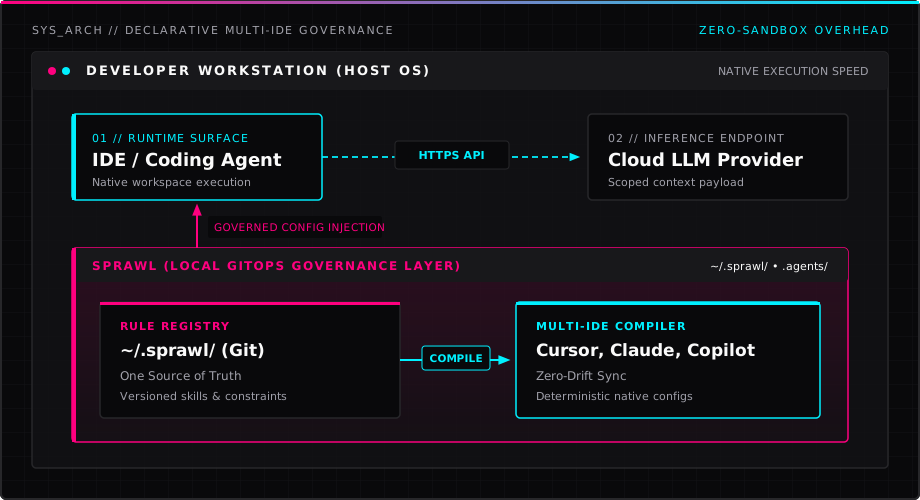
Instead of running a sluggish sandbox daemon or attempting to intercept every editor keystroke, Sprawl CLI treats AI governance as a pure compilation and synchronization problem. Rules, personas, and operating bounds live in a central Git repository (the team's "DNA"). When a developer runs sprawl sync or sprawl ws push, the CLI compiles that single source of truth into native editor configurations across Cursor (.cursorrules), Claude Code (CLAUDE.md), GitHub Copilot (copilot-instructions.md), and Gemini.
By shifting governance from runtime virtualization to declarative GitOps synchronization, we eliminated Node.js, stripped out WebAssembly entirely, and dropped execution latency from 5 seconds to sub-50 milliseconds.
3. The Single-Dependency Rule
This pivot forced another aggressive architectural decision: The Single-Dependency Rule.
To ensure that Sprawl CLI could be dropped into any corporate workstation without triggering security audits, firewall warnings, or dependency conflicts, I stripped out third-party Python packages. I removed Pydantic, PyYAML, Typer, and structlog.
Sprawl CLI now ships with exactly one external dependency: rich (for rendering terminal interfaces). Everything else, from our regex-based frontmatter parser to our workstation sync engine, is built using the Python standard library (stdlib).
The code is lean, readable, and compiles instantly. If a third-party library suffers a supply-chain vulnerability next week, Sprawl is unaffected because the attack surface is virtually zero.
4. Action Plan: Pragmatic Governance for Your Workspace
If you want to prevent AI agent drift and maintain clean workspace standards without installing heavy virtualization layers, execute this three-step governance protocol:
Step 1: Version-Control Your AI Rules as Code
Do not let individual developers paste ad-hoc prompt instructions into local editor settings. Centralize your team's rules, coding standards, and persona instructions in a version-controlled repository (see our open-source reference architecture at github.com/sprawl-software/sprawl-demo-dna). Use automated compilation to sync them deterministically into native editor formats (.cursorrules, CLAUDE.md, .github/copilot-instructions.md).
Step 2: Bound Context with Scoped Rules and Ignore Files
Prevent context dilution and accidental secret exposure at the IDE layer. Use strict workspace ignore files (.cursorignore, .gitignore) to shield sensitive files (.env, credentials, staging dumps), and split large guideline documents into file-glob scoped prescriptive rules that only load when the agent touches relevant files.
Step 3: Audit Drift and Enforce Pre-Commit Quality Gates
Run drift detection (sprawl diff) across your repositories to catch unauthorized local rule overrides. Treat AI-generated code as untrusted input: enforce automated pre-commit hooks and CI checks that validate formatting, schema integrity, and test coverage before any diff is merged.
Conclusion: Architecture Outlasts Hype
The "Magic Prompt" era of casting natural language spells is over. The era of the Sovereign Systems Architect requires structural discipline.
Do not get distracted by the shiny, heavy tools of the academic AI space. Your goal as an engineer is to build software that is replaceable, extendable, and removable. By stripping out Pyodide and Node worker threads, I turned a slow, overengineered sandbox into a fast, native command-line tool that engineering teams can trust.
Do not build for the model of today. Build the lightweight, sovereign governance architecture that outlasts the models of tomorrow.
Related Architecture Essays
- Next in Series: Context is Permanent, Syntax is Temporary: Why Strict AI Governance Costs More Tokens (and Why You Should Pay It)
- Foundational Framework: The 5-Stage Developer Agent Governance Framework: From Shadow Tools to Governed Runtimes
- FinOps Deep Dive: The Rogue Loop Tax: Controlling In-Session Churn and Exfiltration
- Venture Manifesto: Announcing Sprawl.software
Architecting Autonomous Systems?
Stop building fragile monoliths on raw conversational prompts. If you are an engineering lead, CTO, or enterprise architect structuring sovereign agentic workflows, multi-IDE rule consistency, or local developer governance:
- Advisory & Mandates: Connect on LinkedIn or explore younesbaghor.com.
- Developer AI Governance: Explore the open-source GitOps engine at sprawl.software.
Younes Baghor
Fractional Head of AI & Enterprise Systems Architect | Founder, Sprawl.software